



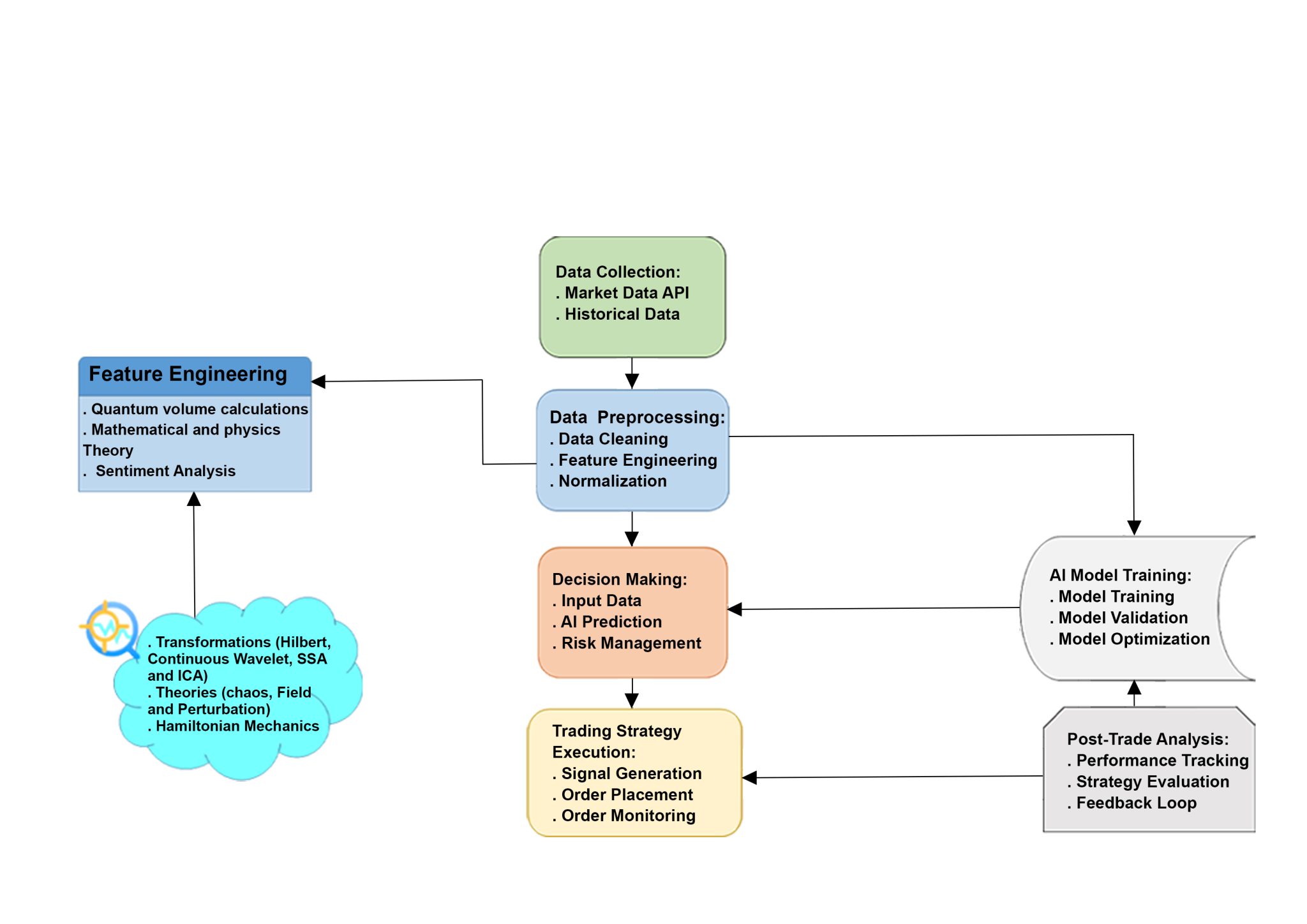
“In today’s fast-moving financial markets, having access to massive amounts of data is just the beginning. What makes the difference is how we interpret that data and turn it into useful insights for making informed trading decisions. This is where feature engineering comes in—one of the most critical steps in building a trading model. But we’re taking feature engineering to the next level by applying advanced mathematical transformations and theoretical concepts from physics to improve the performance of AI-driven trading strategies.
Feature Engineering and Its ImportanceFeature engineering is the process of transforming raw data into a form that AI models can easily understand and use to make accurate predictions. In the world of trading, having well-engineered features allows us to spot trends, patterns, and hidden signals in the market that others might miss. Instead of relying on basic methods like moving averages or simple statistical indicators, we use advanced mathematical transformations and theoretical concepts to build features that provide deeper insights into market movements.
Transformations for Uncovering Market Patterns
Our approach to feature engineering employs powerful mathematical tools to reveal deeper market insights. Hilbert Transformations help detect market cycles by analyzing hidden frequency components of price movements, enhancing trend and reversal detection. Continuous Wavelet Transforms (CWT) captures both time and frequency components of market data, offering insights into price behavior across various time frames. Singular Spectrum Analysis (SSA) simplifies complex time series data into components like trends and noise, filtering out market noise to focus on significant price movements. Independent Component Analysis (ICA) isolates independent factors influencing market changes, such as economic events or external shocks, to reveal hidden drivers of price fluctuations.
Incorporating Theories from Physics and Mathematics
In addition to mathematical transformations, we integrate concepts from physics to model market dynamics more effectively. Chaos Theory aids in understanding the inherent unpredictability of financial markets and identifying signals of major price movements amidst chaotic behavior. Hamiltonian Mechanics, a physics concept used to describe energy in systems, helps model asset momentum and flow, crucial for identifying momentum-driven trades and mean reversion points. Perturbation Theory provides insights into how minor changes in market conditions can lead to significant price shifts, allowing us to better anticipate market reactions to small fluctuations.
The Power of This Approach
By combining these advanced transformations and theoretical models, we can extract much more valuable features from market data than by using traditional techniques alone. This gives AI models a richer understanding of market behavior, allowing them to make more accurate predictions and ultimately help traders make better decisions.
Adding Sentiment Analysis for a Complete View
Another interesting layer we add to our feature engineering process is sentiment analysis. This technique helps us gauge the mood of the market by analyzing news headlines, social media posts, and other forms of textual data. By combining these sentiment signals with mathematically engineered features, we can create even more powerful trading strategies.
”