




Large Language Models (LLMs) are advanced artificial intelligence systems designed to understand, generate, and manipulate human language at scale. Built on transformer architectures — introduced by Vaswani et al. (2017) — they excel at capturing complex relationships between words and phrases across long text spans.
The term large refers to their sheer scale: billions or even trillions of trainable parameters, enabling nuanced understanding of meaning, context, and domain‑specific vocabulary. These parameters are learned from massive text corpora, ranging from books and articles to online forums and specialized datasets.
As LLMs matured, their use stretched far beyond casual conversation—reaching into healthcare, law, education, and finance. In each domain, they can parse complex, specialized language and deliver insights once reserved for human experts.
In finance, however, the first hurdle for any domain‑tuned model is access to high‑quality, timely financial data. Proprietary (closed‑source) solutions like BloombergGPT leverage exclusive datasets and infrastructure, but their high costs and lack of transparency lock most innovators out.
FinGPT answers this gap: an open‑source large language model for the financial sector. Taking a firmly data‑centric approach, it provides researchers and practitioners with accessible pipelines, transparent methodologies, and community‑driven tools to build and customize their own FinLLMs—without the barriers of closed proprietary systems.
FinGPT’s Four‑Layer End‑to‑End Architecture
The main philosophy behind FinGPT is to make financial large language models not only open, but practical, adaptable, and scalable. To achieve this, the framework is built on four interconnected layers, each addressing a specific stage in the lifecycle of a FinLLM — from raw data ingestion to real‑world application.
- Data Source Layer
Captures real‑time information from diverse financial sources to ensure broad market coverage.
- Inputs: Live news feeds, market tick data, corporate disclosures, filings, social media streams.
- Goal: Overcome the problem of delayed or siloed data, providing up‑to‑the‑minute visibility across markets.
- Data Engineering Layer
Automates the preparation of raw, high‑frequency, often noisy financial data for downstream language model training.
- Tackles low signal‑to‑noise ratios common in finance.
- Standardizes formats across sources (APIs, PDFs, HTML, images).
- Applies cleaning, deduplication, and metadata enrichment pipelines.
- LLMs Layer
Fine‑tunes general‑purpose base models into finance‑aware systems that adapt to market dynamics.
- Uses techniques like low‑rank adaptation (LoRA) to keep fine‑tuning computationally efficient.
- Incorporates Reinforcement Learning from Human Feedback (RLHF) for personalization, enabling the model to reflect user‑specific priorities and styles.
- Addresses the challenge of model drift in fast‑changing market environments.
- Application Layer
Demonstrates how FinGPT can be embedded into diverse financial workflows.
- Examples: Robo‑advising tools, algorithmic trading systems, portfolio analytics dashboards, low‑code platforms for custom analysis.
- Functions as a sandbox for developers to prototype new financial AI solutions without starting from scratch.
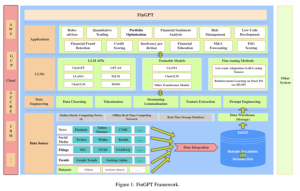
Why This Matters:
This layered structure turns FinGPT from a static model into an adaptable platform — one that handles data volatility, stays relevant in dynamic markets, and empowers institutions of all sizes to evolve their own financial AI capabilities at minimal cost.
FinGPT vs Proprietary Financial LLMs
Proprietary financial LLMs, such as BloombergGPT, have demonstrated impressive capabilities by leveraging exclusive datasets and extensive institutional infrastructure. Their advantage lies in sheer data depth and controlled pipelines; however, those same characteristics create significant barriers for the broader market:
- Restricted Access: Training data, model weights, and fine‑tuning methods are kept private, making independent validation or adaptation impossible.
- High Costs: Only large institutions can afford the computational resources and licensing fees required to use or replicate such models.
- Opaque Operation: Without transparency, stakeholders must trust the output without knowing how conclusions are drawn — a limitation in high‑stakes finance where explainability is critical.
FinGPT’s Differentiation
- Open‑Source Core: Anyone can inspect, modify, and deploy the model — from researchers to boutique fintech firms.
- Data‑Centric Accessibility: The automatic data curation pipeline allows broad, real‑time market coverage without privileged datasets.
- Lightweight Fine‑Tuning (LoRA): Low‑rank adaptation keeps computational costs manageable, enabling customization on consumer‑grade hardware.
- Collaborative Ecosystem: Developed under the AI4Finance Foundation, FinGPT benefits from global contributions, transparent code, and shared best practices.
Where proprietary solutions centralize control and benefit a narrow set of stakeholders, FinGPT decentralizes capability, opening financial AI to SMEs, universities, startups, and even independent analysts. In practical terms, this means faster innovation cycles, more adaptable tools, and a stronger alignment with the principles of open finance.
|
Dimension |
Proprietary LLMs (e.g., BloombergGPT) | FinGPT (Open‑Source) |
| Data Access | Exclusive, closed datasets; no public retrieval. | Open data pipelines with real‑time Internet‑scale coverage. |
| Transparency | Opaque model architecture and weights; limited documentation. | Fully transparent code, weights, and methodology. |
| Cost & Infrastructure | High licensing fees; large-scale compute requirements; restricted to major institutions. | Low-cost fine‑tuning (LoRA); runs on consumer‑grade hardware. |
| Customization | Limited to vendor‑approved use cases; rigid adaptation. | Full customization for specific markets, languages, or asset classes. |
| Collaboration | Vendor‑led development; closed contributor ecosystem. | Global community contributions under AI4Finance Foundation. |
| Innovation Speed | Dependent on corporate roadmap; slower cross‑domain integration. | Rapid iteration via open‑source community and modular architecture. |
| Explainability | Black‑box outputs with limited interpretability tools. | Transparent decision pipeline; supports explainability in high‑risk contexts. |
| Target Audience | Large financial institutions with deep budgets. |
Startups, SMEs, universities, independent analysts, retail investor platforms. |
Use Cases & Real‑World Impact
FinGPT’s open‑source framework is not just a technical innovation — it is a bridge to practical applications across the financial sector. By combining real‑time data acquisition, lightweight fine‑tuning, and transparent pipelines, it enables solutions that were previously out of reach for all but the largest institutions.
- Robo‑Advisory at Scale
A boutique wealth‑tech startup can deploy FinGPT to deliver personalized portfolio recommendations for thousands of clients.
Using LoRA fine‑tuning, the advisory model can adapt to regional market conditions, local regulations, or niche asset classes — without requiring expensive GPU clusters. This levels the playing field for smaller players competing with major financial advisory firms.
- Sentiment‑Driven Algorithmic Trading
By integrating FinGPT’s Data Source and Data Engineering layers into existing algo‑trading pipelines, traders can parse news headlines, earnings transcripts, and social media sentiment in real time.
The output — clean, high‑signal text features — becomes actionable triggers for trades, reducing latency between market events and strategy execution.
- Low‑Code Financial Research Bots
For analysts without deep software engineering skills, FinGPT’s API and Jupyter‑ready demos allow quick creation of domain‑specific research assistants.
Imagine a credit analyst configuring a bot to pull and interpret quarterly reports, highlight risk metrics, and summarize competitive positioning — all through a few lines of Python.
- Risk Management & Compliance Monitoring
FinGPT’s transparent model outputs make it suitable for regulatory use cases. Compliance teams can fine‑tune models to flag anomalies in filings, spot conflicting statements in CEO communications, or detect patterns that suggest market manipulation.
Because the code and logic are open, outputs can be audited for explainability — addressing a critical gap in opaque proprietary systems.
- Education & Academic Collaboration
Business schools and universities can embed FinGPT into coursework, allowing students to build FinLLM pipelines from scratch.
This hands‑on exposure not only prepares graduates for the AI‑driven finance industry but also strengthens the global open‑source contributor pool, accelerating innovation.
Future Outlook & Roadmap
FinGPT’s trajectory reflects the broader evolution of open finance — a shift from siloed, proprietary ecosystems toward collaborative, transparent, and adaptive AI infrastructures.
- Expanded Data Horizons
Current FinGPT pipelines cover news, filings, social media, and structured market data. The next phase will integrate alternative signals such as ESG disclosures, satellite imagery for supply‑chain insights, and blockchain transaction flows — widening the model’s ability to detect emerging risks and opportunities.
- Multi‑Agent Financial Systems
By embedding FinGPT into agent‑based architectures, future deployments could assign specialized AI “roles” — one agent tracking macroeconomic indicators, another focusing on sector analysis, and a third on compliance. This mirrors human research teams but scales globally and operates 24/7.
- Real‑Time Personalization at Scale
New fine‑tuning strategies and adaptive inference will enable FinGPT to update user profiles on the fly, delivering hyper‑personalized insights without retraining from scratch. In portfolio management, this would mean instant risk re‑balancing as market volatility shifts.
- Integration with Decentralized Finance (DeFi)
The open‑source ethos aligns with DeFi principles. FinGPT could become a core analytical engine for decentralized trading platforms, automated lending protocols, and DAO‑governed investment funds — providing transparent model logic for on‑chain decision‑making.
- Governance, Standards & Compliance
As adoption spreads, standardized audit trails for AI decision processes will become mandatory. FinGPT’s open architecture positions it as a pioneer in explainable financial AI (XFAI) frameworks, ensuring regulators and users can trace outputs back to the underlying data and reasoning.
- Community‑Driven Innovation
The AI4Finance Foundation will continue hosting benchmarks, hackathons, and collaborative development sprints. This federated R&D model ensures that regardless of geography or budget, contributors can shape FinGPT’s growth.
FinGPT stands at the intersection of technical scalability and institutional trustworthiness.
Its roadmap points toward a world where advanced financial AI is no longer the domain of a few elite players, but a shared resource that accelerates research, empowers small innovators, and promotes systemic transparency in finance.
Sources & Further Reading
- Yang, H., Liu, X., & Wang, C. D. (2023). FinGPT: Open‑Source Financial Large Language Models. AI4Finance Foundation. https://github.com/AI4Finance-Foundation/FinGPT
- Wu, S., Irsoy, O., et al. (2023). BloombergGPT: A Large Language Model for Finance. arXiv:2303.17564.
- Liu, X., Yang, H., Rui, J., et al. (2022). FinRL‑Meta: Market Environments and Benchmarks for Data‑Driven Financial Reinforcement Learning. NeurIPS.
- Hu, E. J., Shen, Y., et al. (2021). LoRA: Low‑Rank Adaptation of Large Language Models. ICLR.
- Dettmers, T., Pagnoni, A., et al. (2023). QLoRA: Efficient Fine‑Tuning of Quantized LLMs. arXiv:2305.14314.
- OpenAI. (2023). GPT‑4 Technical Report.
- AI4Finance Foundation. (2025). FinRobot: AI Agent for Equity Research and Valuation. https://github.com/AI4Finance-Foundation/FinRobot
- Araci, D. (2019). FinBERT: Financial Sentiment Analysis with Pre‑trained Language Models. arXiv:1908.10063.